What PDRN (polydeoxyribonucleotide, Sodium DNA) is
PDRN — polydeoxyribonucleotide — is a mixture of DNA fragments, purified until the proteins are gone and only the strands of nucleotides remain.
The pharmaceutical form is traditionally made from the sperm DNA of salmon trout (Oncorhynchus mykiss) or chum salmon (O. keta), with fragments between 50 and 1,500 kilodaltons (kDa) in size (Squadrito et al., 2017). That is why skin care labels often call it "salmon DNA".
On a cosmetic ingredient list you will usually see it as Sodium DNA — the sodium salt of DNA. The EU cosmetic ingredient database lists one function for it: skin conditioning (COSMILE / CosIng).
A short history of PDRN
- 1980s · Italy
Researchers begin studying PDRN as a wound-healing drug (NewBeauty).
- 1990s · Korea
PharmaResearch starts using salmon-derived PDRN as a pharmaceutical ingredient (NewBeauty).
- 2014 · Italy
A randomised, double-blind, placebo-controlled trial in 216 people with diabetic foot ulcers: after eight weeks of PDRN injections, about 37% had fully closed ulcers versus about 19% on placebo (reported by ScienceDaily; Journal of Clinical Endocrinology & Metabolism).
- 2014 · Korea
PharmaResearch launches Rejuran, an injectable polynucleotide that creates the "skin booster" category across Asia (NewBeauty).
- 2017 · Korea
The first widely known topical PDRN ampoule launches — and PDRN serums become a global trend (NewBeauty).
- 2025–26 · Everywhere
Dermatologists and formulators start asking the hard question: does PDRN in a bottle reach where it needs to go? (Dermatology Times, Modern Aesthetics)
What the PDRN research shows
Most of PDRN's research comes from medicine, not cosmetics. A 2017 review from the University of Messina describes two proposed ways it works (Squadrito et al.):
- Adenosine A2A receptor activation — the review calls this its most relevant mechanism, seen in lab and animal studies.
- The "salvage pathway" — PDRN breaks down into nucleosides and nucleotides that cells can reuse as raw material when making them from scratch is hard.
The same review lists clinical uses including diabetic foot ulcers, venous leg ulcers, skin-graft donor sites and corneal healing. These were medical treatments, mostly injected, studied by doctors. None of this research was done on a cosmetic serum, and none of it should be read as a promise about one.
The 2017 review notes that its lead author received research support from Mastelli, the Italian company that makes PDRN. We mention it because you should know who funds the research you read.
The PDRN serum question — the part most brands leave out
Size matters
Molecules that pass through intact skin on their own are generally under about 500 daltons. PDRN fragments are 50,000 to 1,500,000 daltons — roughly a hundred to three thousand times larger. A 2025 study in Pharmaceutics describes this size, together with PDRN's negative electrical charge, as limiting how well it passes the skin's outer layer and enters cells (Pharmaceutics, 2025).
Dermatology Times' 2026 review calls the topical evidence "honest uncertainty": one small 2025 study of a low-molecular-weight PDRN showed modest gains in under-eye elasticity after four weeks, a preliminary finding. It suggests that much of what people feel from PDRN serums may come from the ingredients around it (Dermatology Times).
Researchers are working on ways around the size problem — smaller fragments, encapsulation, and new processing methods — but most of that work is still in the lab (Pharmaceutics, 2025).
So what can a PDRN serum honestly do? Based on what is published today: PDRN is a skin-conditioning ingredient that sits on and in the skin's surface. Whether it does more depends on its fragment size, how it is delivered, and whether the brand has tested it. Treat any claim that goes beyond skin conditioning — or that compares a serum to an injection — with care.
Why — and how — Skandoir uses PDRN
Skandoir uses PDRN because it belongs to the Korean skin science our line is built on, and because we think the story of how it works should be told honestly, not hidden. We make no claim that it works like an injection — or that it does anything beyond what our own testing shows.
| Skandoir serum | PDRN | What carries the formula |
|---|---|---|
| Nº 01 · Adenosine 0.75% + Redensyl™ 3% | 0.1% | Adenosine, Redensyl™, caffeine, creatine, two hair peptides, ectoin |
| Nº 02 · Adenosine 0.75% + Creatine 1% | 0.1% | Adenosine, creatine, caffeine, rice protein, ectoin |
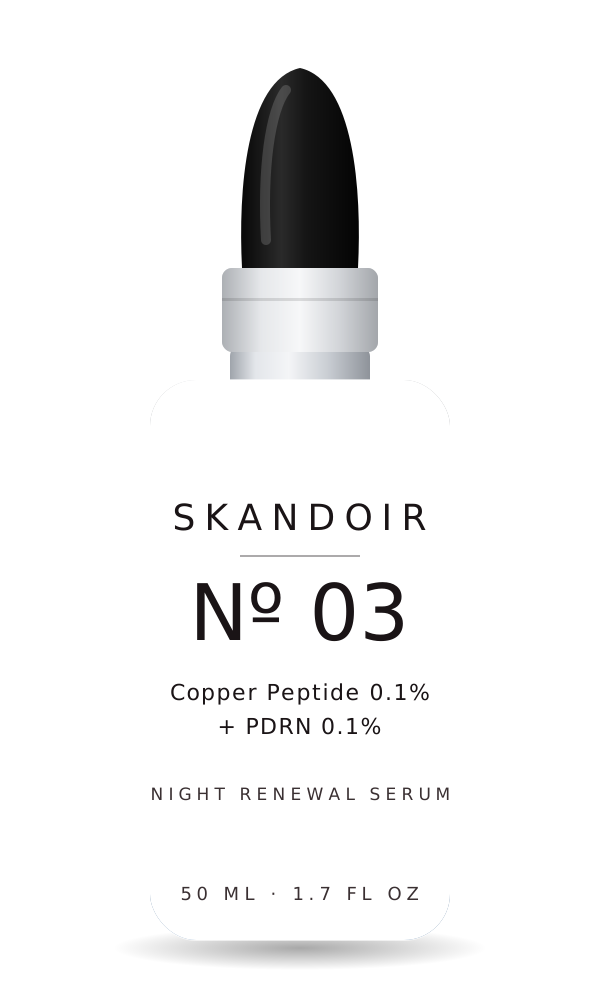
| Nº 03 · Copper Peptide 0.1% + PDRN 0.1% | 0.1% | Copper peptide, Tripeptide-32, adenosine, ectoin 2%, centella, hyaluronate — in a lecithin liposome |
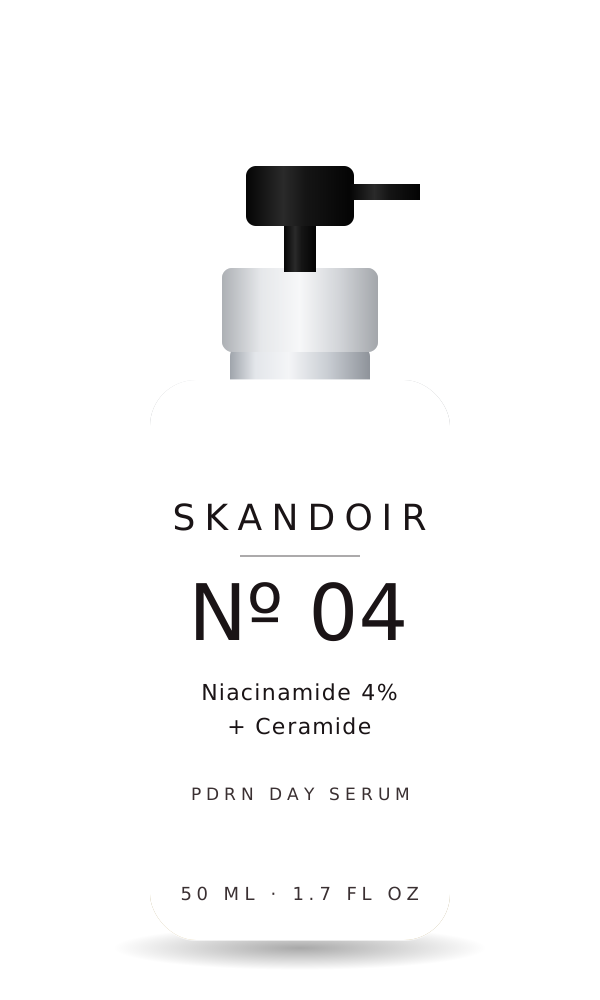
| Nº 04 · Niacinamide 4% + Ceramide | 0.05% | Niacinamide, ceramide NP + cholesterol + linoleic acid, lipid vitamin C, ectoin 2% |
All four Skandoir serums are laid out side by side on Skandoir serums compared.
How Skandoir handles PDRN
- Cosmetic-grade sodium DNA with fragments of 650 kDa or less — at the smaller end of the usual range.
- Pre-dissolved in cold water for two hours and added below 40 °C with gentle stirring, because heat and high shear break DNA strands.
- No cationic ingredients in the same formula, because they bind and precipitate DNA.
- In Nº 03, PDRN and the copper peptide are carried in a hydrogenated-lecithin liposome. We do not yet have penetration data for it, so we make no penetration claim.
What Skandoir is testing
Before launch, Nº 03 and Nº 04 go through a 20-person instrument study on Indian volunteers measuring skin hydration (Corneometer) and water loss (TEWL), plus a 50-person skin-safety patch study. We will publish the results here — including if they are modest.
How to choose a PDRN serum
Whichever brand you buy, these questions separate a careful formula from a trend label. The first three come from the formulation criteria in Modern Aesthetics.
- Is the percentage stated? "With PDRN" can mean a trace. Look for a number.
- Is the fragment size disclosed? Smaller fragments have a better chance in the skin than full-size PDRN.
- Is there a delivery system — and any data for it? Encapsulation or similar, ideally with independent penetration testing.
- What else is in it? Hydrating and barrier ingredients may be doing much of the visible work. Make sure they suit your skin.
- What is the price per ml? Divide the price by the volume. A higher price should come with more disclosure, not less.
- Is it fragrance-free? Helpful if your skin reacts easily.
What is PDRN in skincare? The molecule behind Korea's skin trend — and what it can honestly do in a serum.: questions and answers
Is PDRN the same as salmon DNA?
Usually, yes. Pharmaceutical PDRN is traditionally made from the sperm DNA of salmon trout or chum salmon. On a cosmetic label it appears as Sodium DNA.
What does PDRN do in a serum?
The EU cosmetic ingredient database lists Sodium DNA with one function: skin conditioning. Its strongest research is as an injected medical treatment, and the topical evidence is still early.
How much PDRN is in Skandoir serums?
PDRN is at 0.1% in Skandoir Nº 01, Nº 02 and Nº 03, and at 0.05% in Nº 04. In Nº 03 it is carried in a lecithin liposome.
Does PDRN penetrate the skin?
PDRN fragments are 50,000 to 1,500,000 daltons, far larger than the roughly 500 daltons that typically passes intact skin. Fragment size and delivery decide a lot. Skandoir makes no penetration claim.
Is PDRN vegan?
Traditionally, no: PDRN is fish-derived. Skandoir will confirm the source species of its Sodium DNA with the supplier before launch and publish it here.
How do I choose a PDRN serum?
Look for a stated percentage, a disclosed fragment size, a delivery system with data, a sensible supporting formula and a fair price per ml. Fragrance-free helps if your skin reacts easily.
Sources for this What is PDRN in skincare? The molecule behind Korea's skin trend — and what it can honestly do in a serum. article
- Squadrito F, et al. Pharmacological Activity and Clinical Use of PDRN. Frontiers in Pharmacology, 2017.
- ScienceDaily. Tissue repair drug helps heal diabetic foot ulcers, February 2014 (trial in the Journal of Clinical Endocrinology & Metabolism).
- NewBeauty. The history of PDRN.
- Plasma-engineered PDRN: surface charge neutralisation and nanosizing. Pharmaceutics, 2025; 17(9):1136.
- Bosslett M. Social Media Mythbusters: PDRN Serums. Dermatology Times, 2026.
- Ike M. Polydeoxyribonucleotide in a bottle depends on formulation science. Modern Aesthetics, July/August 2026.
- COSMILE Europe. Sodium DNA — INCI detail (CosIng function: skin conditioning).
This page is educational and is not medical advice. Skandoir serums are cosmetics; they are not intended to treat any condition. For skin or hair disease, see a doctor.
Last reviewed: 13 October 2026